The European Council members met for an informal dinner to discuss the results of the 2024 European Parliament elections and possible candidates for the leadership positions in the coming EU institutional cycle.
The Heads of State or Government did not come to any decision on the appointments, and indeed they were not due to take any formal decision at this stage in the procedure. High-level discussions will now take place between the European Council and the European Parliament, as well as between the political families. The EU leaders are expected to agree on the package of high-level EU posts, and on the political priorities for the next 5 years, at the formal European Council meeting on 27 28 June 2024.
On 17 June, the European Council members met for an informal dinner to discuss the results of the 2024 European Parliament elections and possible candidates for the leadership positions in the coming EU institutional cycle. The Heads of State or Government did not come to any decision on the appointments, and indeed they were not due to take any formal decision at this stage in the procedure. High-level discussions will now take place between the European Council and the European Parliament, as well as between the political families. The EU leaders are expected to agree on the package of high-level EU posts, and on the political priorities for the next 5 years, at the formal European Council meeting on 27-28 June 2024.
Start of the meeting
As usual at the start of the meeting, the President of the European Parliament, Roberta Metsola, addressed the members of the European Council. While emphasising that the 2024 European elections had seen the 'highest voter turnout in over 30 years', she stressed that the main takeaway from the elections was that 'the constructive pro-European centre holds'. This view was supported by German Chancellor Olaf Scholz, ahead of the meeting, who underlined that the elections had brought a stable majority of the political forces that had traditionally worked closely together in the European Parliament (the European People's Party – EPP, the Socialists and Democrats – S&D, and the Liberal family – Renew Europe). Moreover, Metsola informed the EU leaders that the majority of political groups in Parliament supported the 'lead candidate' process and, in view of the results of the elections, agreed that the EPP was once again the largest political group in the European Parliament. Metsola's address was followed by a statement by Ursula von der Leyen, the current European Commission President and EPP lead candidate for the post in the coming term. She presented her views on the future of the European Union.
As flagged up in the EPRS outlook, the purpose of this meeting was not to take a decision. This point was also stressed by some Heads of State or Government before the meeting, notably the Irish Taoiseach, Simon Harris, and reiterated by the European Council President, Charles Michel, after the meeting. The objective was to reflect on the election results and begin discussions on possible candidates for the EU top jobs ahead of the formal European Council meeting on 27-28 June.
Senior EU institutional posts to be filled
In 2024, the appointments to be made include three high-level EU positions: the presidents of the European Commission and of the European Council, and the High Representative of the Union for Foreign Affairs and Security Policy/Commission Vice-President (HR/VP). Several EU leaders, notably Dutch Prime Minister Mark Rutte, stressed that the decisions on these positions would be taken as a 'package'. Harris called for 'a balanced package reflecting the results of the European elections, geography and size of Member States'.
Another high-level post – that of European Parliament President – must also be filled at the start of the new institutional cycle. The European Council has no legal involvement in this case, as underlined by Metsola. However, Parliament does not make this choice in a vacuum and has to consider the wider context, notably the election results and the other high-level appointments. On 17 June, Metsola put forward her own candidacy to continue in the post of European Parliament President.
Party political balance in the EU institutions when filling senior posts
The allocation of high-level EU positions has a strong political party dimension (see EPRS briefing on European political parties and the European Council). Michel confirmed this when stating that 'the political parties are playing a role and that is natural in such a political moment'; he also indicated that the European political families had made proposals for the EU institutional leadership posts.
Figure 1 – Party political balance in the European Council and the European Parliament
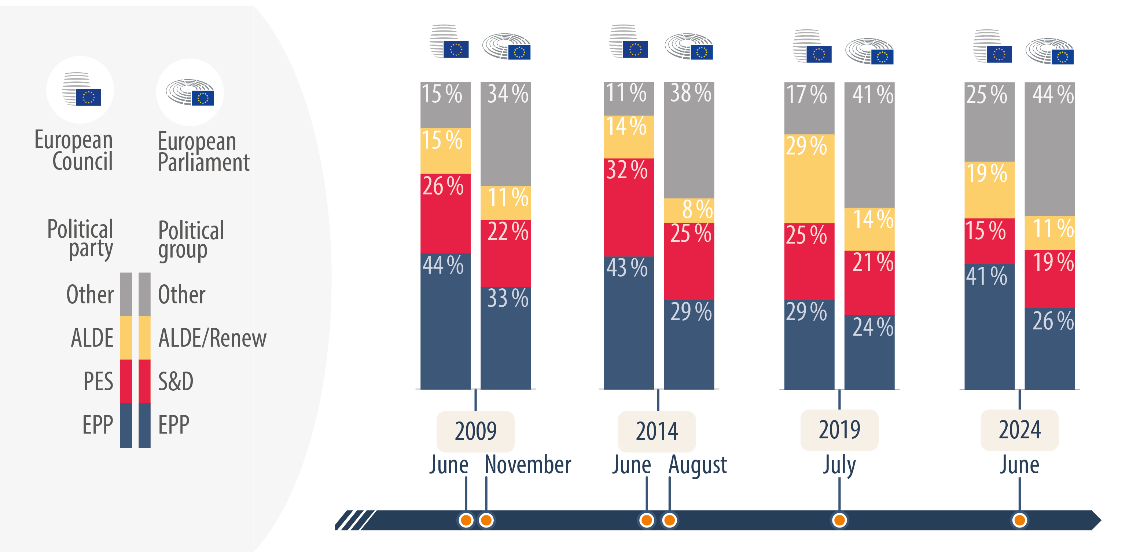
Source: EPRS.
NB Figure 1 represents the party political balance on 18 June 2024. For Parliament, this is based on preliminary election results. The membership of the European Council changes on average every 2 months and could be different at the next meeting.
more at EP research
© EPRS - European Parliamentary Research Service
Key

Hover over the blue highlighted
text to view the acronym meaning

Hover
over these icons for more information

Comments:
No Comments for this Article