The goal is to increase competitiveness so Europe needs to reduce the volume of regulation and improve its quality... emphasised by Mario Draghi in his report on the challenges facing the European economy. The question is: can the EU regulate less and regulate better?
The goal is to increase competitiveness, and for that, Europe needs to reduce the volume of regulation and improve its quality. This is one of the points emphasised by Mario Draghi, who on 9 September presented his report on the challenges facing the European economy. The question is: can the EU regulate less and regulate better?
The EU has been a force for deregulation for years. It removed regulatory barriers that kept EU member state’s markets apart until the four freedoms became, more or less, a reality. The Single Market is one of the EU’s most impressive economic achievements and a driver of its prosperity, as highlighted by Enrico Letta. As a result of these efforts, in some economic sectors, the EU Single Market is as integrated as the US internal market. Take the OECD Product Market Regulation (PMR) indicator, which measures the degree to which policies promote or inhibit competition. A higher OECD PMR score indicates a more restrictive regulatory framework. Between 1998 and 2013, the EU’s PMR dropped by 40 percent, whereas in the US, it decreased by only 2 percent.
Then something happened. Worried about the potential fragmentation of the Single Market, the EU took on the task of drafting regulation for the entire union. In addition to long-standing policy areas such as agriculture, energy, telecommunication, transport, and financial services; it began regulating all aspects of life: consumer protection; climate policy, the circular economy; digital markets; technology – the list goes on. When it comes to regulation, the EU has become part of the problem rather than the solution.
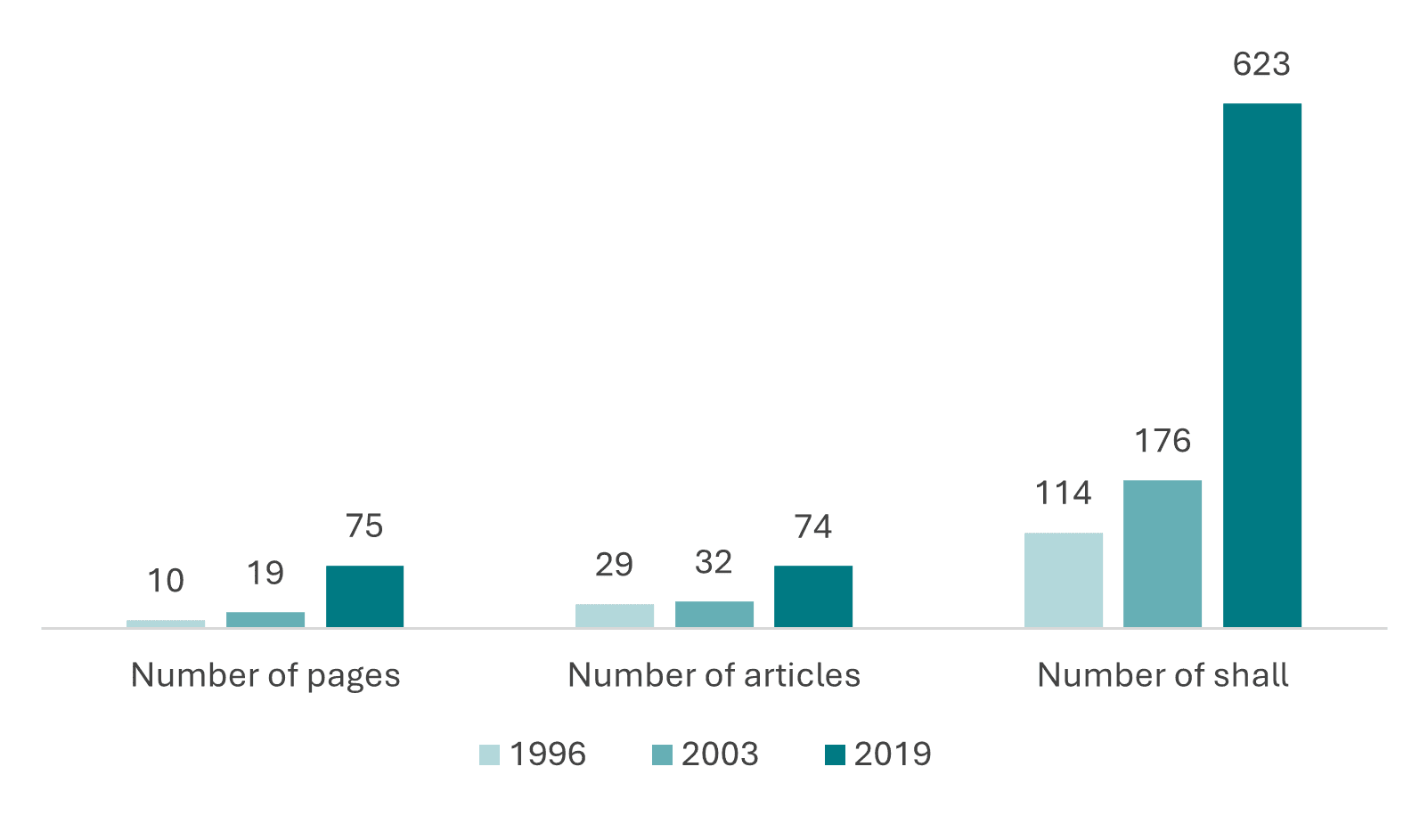
Climbing down from the peak of overregulation requires significant efforts and determination. Each iteration of EU regulation has grown increasingly complex. Consider the 1996, 2003, and 2019 versions of the Electricity Directive. Figure 1 shows that, over time, each Directive regulating the EU electricity market has become more cumbersome – with an increasing number of pages and articles – and more restrictive, as reflected by the growing number of “shall” clauses indicating obligations. True, the word shall can be used in EU legislation to prevent member states from imposing market restrictions, and as such, it can have a positive effect on competition. However, while only indicative, the figures below illustrate the increasing levels of regulatory restrictions in the EU economy.
Figure 1: Number of pages, articles and the word shall in the 1996, 2003, and 2019 Electricity Directive
ECIPE
Key

Hover over the blue highlighted
text to view the acronym meaning

Hover
over these icons for more information

Comments:
No Comments for this Article