
|
|
The discourse surrounding the EU’s supposed over-reliance on digital services imports from non-EU countries, particularly the US, has been a recurrent topic among some political circles. However, this viewpoint tends to oversimplify and misrepresent the nuanced and complex reality of the EU’s status within the global Information and Communication Technology (ICT) sector and digitally enabled trade.
A thorough analysis of trade data and trends clearly illustrates that the EU’s engagement with foreign (non-EU) digital services, notably from the US, represents a strategic economic advantage, bolstering Europe’s competitiveness and fostering productivity growth. Below we underline the critical importance of openness to foreign innovation and technology diffusion for the EU’s economic future.
Firstly, the overall trade patterns in the ICT sector highlight the EU’s strength and resilience. In 2021, the EU’s total ICT trade was approximately US$682 billion, with the US contributing $59.6 billion (see Figure 1). Significantly, European businesses exported US$453.5 billion of ICT services globally, juxtaposed with importing close to US$228 billion worth of US ICT services. This positive trade balance in the ICT services sector exemplifies the EU’s capability not only to absorb but also to innovate and compete on a global scale. It dismantles the argument that the EU is overly dependent on digital services imports; rather, it showcases the EU as a pivotal player in the global digital economy.
Figure 1: EU ICT services trade by partner region in 2021, in billion USD
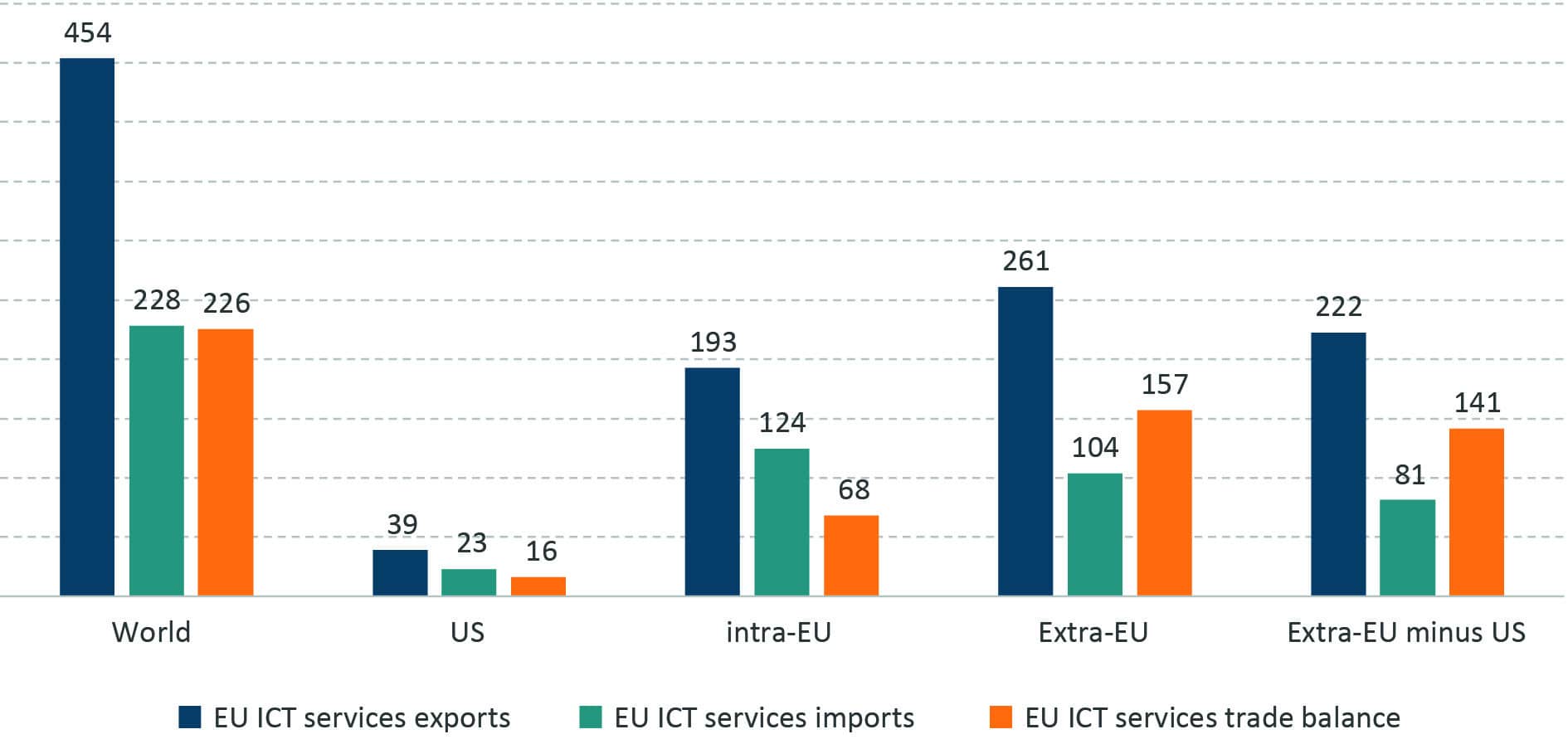
Source: UNCTAD. ICT services: telecommunications, computer, and information services.
The export of ICT and software services is a significant activity undertaken by companies of varying sizes across the EU. Data from large EU-based corporations vividly illustrates this reality, showcasing their extensive involvement in the global market. These enterprises span a diverse range of specialties, from advanced software solutions and digital infrastructure to cutting-edge telecommunications and cloud services. They operate in a vast array of countries outside the EU, indicating not only their competitive edge in the international arena but also their critical role in driving forward the digital transformation worldwide.
Table 1 exemplarily illustrates the global outreach of globally operating EU-headquartered companies in the ICT and software services sector, highlighting their expansive export operations to non-EU jurisdictions. For example, SAP SE from Germany leads with a wide array of software solutions including enterprise resource planning (ERP) systems, customer relationship management (CRM), supply chain management (SCM), business intelligence (BI), and various other applications, catering to a diverse clientele across countries including India, US, China, and many others. In the same manner, ASML Holding NV, based in the Netherlands, specializes in advanced lithography equipment designed for semiconductor manufacturing. They provide software and metrology and inspection products and EUV/DUV lithography systems to key markets in East Asia, while also extending support operations to the Middle East and Africa....
more at ECIPE