Summary
- Putin’s full-scale invasion of Ukraine and Trump’s second election win have transformed the context of EU-UK relations, a new poll by ECFR shows. The prevailing public view in Britain and major EU states is that the relationship should become closer.
- On issues ranging from Ukraine to China, Brits are reluctant to follow Trump’s lead. They look more to Europe than to America – not just for their economic future and migration, but also for their security.
- Where leaders on both sides of the English Channel are still sticking to their red lines, voters are more pragmatic. Most continental respondents believe offering the UK better access to the single market is a price worth paying for a closer security partnership. In Britain, a majority of both anti- and pro-Brexit voters support compromises facilitating movement and trade. Both sides have more political room than they realise.
- The British government has a clear opportunity to win back pro-European voters without alienating its decisive “hero voters”, the “red wall” of working-class English seats in the Midlands and north, or Brexit supporters in general.
The shifting tectonics of EU-UK relations
February 2022 and November 2024 were two successive hammer blows to what remained of the post-Cold War geopolitical order in Europe. If it was not already abundantly clear that the continent has entered a new era, it is now. Voters in the United Kingdom and the European Union grasp this, and are rethinking old geopolitical assumptions. One of the most striking shifts concerns the relationship between the two.
While the British government and the European Commission are edging only slowly towards closer cooperation, public opinion is far ahead of them. That is the central finding of a major new ECFR opinion poll conducted in the weeks immediately after the United States presidential election. Comprising 9,278 respondents across the UK and the EU’s five most populous countries, it shows strong support on both sides for an ambitious reset that cuts across many of the red lines that constrained the relationship before Donald Trump’s win in November.
A majority of voters in Germany and Poland – and a plurality in France, Italy and Spain – think that the EU should be willing to make economic concessions to the UK to secure a closer security relationship. And in the UK, a majority of voters (including 54 per cent of those who voted for Brexit in 2016) would be willing to accept free movement in exchange for a stronger economic relationship with the EU. Our polling also shows that when it comes to their economic future, tackling migration, and even security, more Brits look to the EU than to the US as their country’s most important partner.
The Brexit referendum is now over eight years behind us. When British voters decided to leave the EU, Barack Obama was still in the White House. The UK was enjoying a much-hailed “golden age” in its relations with China. The covid-19 pandemic had not yet struck. And Russian president Vladimir Putin had yet to launch his full-scale invasion of Ukraine. Many Brexiteers hoped that Britain would thrive as a free-wheeling, buccaneering trading nation in a world of ever-more open markets. On the EU side, although most governments were distressed by British voters’ decision, quite a few were also quietly relieved to see the back of an often troublesome and reluctant partner.
But our poll shows that in the minds of many voters, we are in a new world. In every country surveyed, the prevailing view is that EU-UK relations should become closer rather than staying the same or becoming more distant. The war in Ukraine, tensions with China, and now a looming second Trump term are forcing continental Europeans and Brits to look at their relationship in a new light. This report charts those poll findings: starting with the overall openness to a reset; then surveying the new pragmatism in Britain and then the EU; before showing the political breadth of this sentiment in the UK especially. It argues that there is more political room for a bold reset than governments generally realise.
The feeling’s mutual: The new cross-Channel consensus
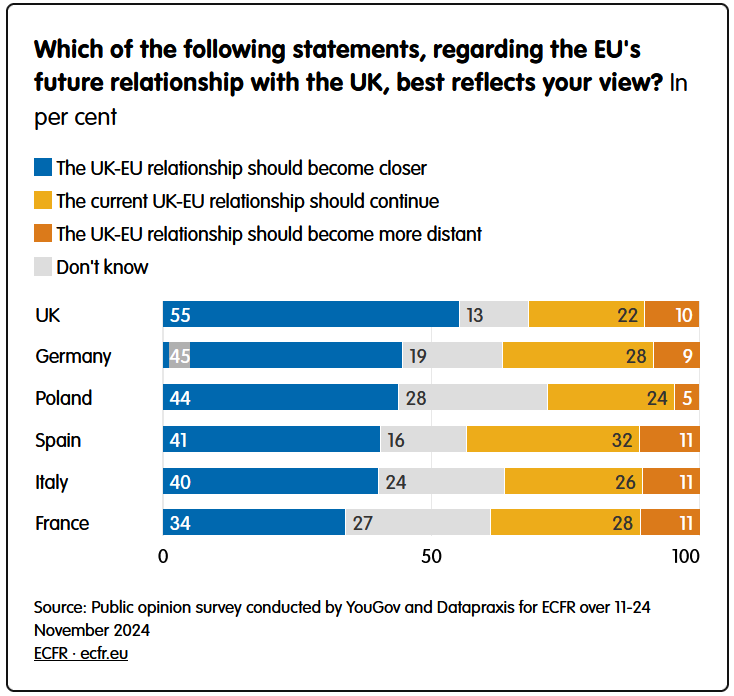
It would be one thing if the appetite for such a reset were present only on one side of the Channel, or in just one narrow segment of the political spectrum. But our poll finds a strikingly broad consensus both in the UK and in the EU that the time is ripe. In every country polled, the prevailing view is that the relationship should become closer rather than staying the same or becoming more distant.
more at ECFR
© ECFR - European Council on Foreign Relations
Key

Hover over the blue highlighted
text to view the acronym meaning

Hover
over these icons for more information

Comments:
No Comments for this Article